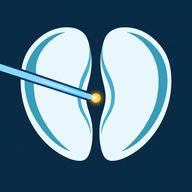
HoLEP is a minimally invasive operation to treat symptoms caused by benign prostate enlargement. A holmium laser separates and removes the enlarged tissue that obstructs urination, through the urethra and without an external incision.
The method allows thorough removal of the prostate adenoma, with lasting improvement in urination. It can be used for prostates of different sizes, including very large glands. The decision to operate is based on symptoms, examination findings, bladder function and the patient's overall health.
Why choose HoLEP and how does it differ from other procedures?
HoLEP is among the most extensively studied methods of endoscopic treatment for an enlarged prostate. Its main advantage is removal of the adenoma along the natural plane separating it from the outer part of the prostate.
Thorough removal of the prostate adenoma
The enlarged inner part of the prostate is separated from the capsule and removed. This creates space for urine to flow and provides a lasting effect.
Surgery without an external incision
Instruments are introduced through the urethra. No skin incision or external stitches are needed to remove the tissue.
Suitable even for very large prostates
Prostate size alone does not limit the use of HoLEP. The method may also be suitable for prostates larger than 150 ml, after assessment of the anatomy and the operating team's experience.
Laser control of bleeding
The holmium laser allows tissue separation and treatment of bleeding sites. Compared with conventional open surgery, HoLEP usually involves less blood loss and a shorter hospital stay. A risk of bleeding remains and is assessed individually.
Tissue for histopathological analysis
The removed tissue is sent for microscopic examination. The analysis may reveal unexpected changes, including cancer, but does not replace the necessary assessment of suspected prostate cancer before surgery.
Who is HoLEP suitable for?
HoLEP is considered when an enlarged prostate obstructs urination, particularly in patients who:
- have a markedly weak stream, difficulty starting urination or a feeling of incomplete bladder emptying;
- have symptoms that are not adequately controlled by medication, or experience side effects from treatment;
- have urinary retention and depend on a catheter;
- have a large prostate and require extensive removal of obstructing tissue;
- develop obstruction again because of residual or regrown tissue after previous treatment.
For older patients and those with chronic illnesses, overall health, suitability for anaesthesia and expected benefit are assessed. Age alone is not the only criterion for choosing a method.
Frequent or night-time urination may have other causes. Before surgery, it is therefore important to assess how much the prostate contributes to symptoms and how much is due to bladder function or other conditions.
Has HoLEP been clinically studied and included in official guidelines?
Yes. HoLEP has been studied in numerous clinical trials, including comparisons with TURP and open surgery, with long-term follow-up.
The method is included in professional recommendations from:
- the European Association of Urology (EAU) — a strong recommendation for HoLEP as an alternative to TURP or open surgery in suitable patients;
- The American Urological Association (AUA) — HoLEP is one of the options for endoscopic enucleation of the prostate;
- The UK's NICE institute — HoLEP is among the recommended surgical methods for symptoms caused by benign prostate enlargement.
The choice is tailored to the findings and the patient's priorities, taking into account the surgeon's experience with the particular technique.
What are the results, and how long do they last?
In appropriately selected patients, a stronger stream, easier initiation of urination, less straining and better bladder emptying are expected. Improvement is assessed using the symptom questionnaire (IPSS), urinary flow measurements and the amount of urine remaining in the bladder after urination.
Lasting effect
In a published series of 949 patients followed for up to ten years, among the available results at the ten-year assessment the mean IPSS was 3.8, and maximum urinary flow was 23.4 ml/s. Mean follow-up for the entire series was 62 months.
Low rate of repeat surgery for adenoma
In the same series, repeat surgery for residual adenoma was required in 0.7% of patients during follow-up. This figure refers to a specific reason for repeat surgery, rather than all possible subsequent urological interventions.
Night-time urination and sudden urgency
These symptoms may improve, but their outcome also depends on bladder function and other causes. A stronger stream may be noticed sooner than a reduction in urinary frequency and nocturia.
Does HoLEP help patients who have a catheter because of urinary retention?
Yes. HoLEP may restore independent urination when an enlarged prostate is the main cause of urinary retention.
In a study analysing one surgeon's first 500 consecutive HoLEP procedures, three months after surgery the proportions of patients without a catheter were 98.9% of those with acute retention and 98.8% of those with non-neurogenic chronic retention. These results apply to those patient groups and that follow-up period.
Success also depends on the bladder muscle's ability to contract. If bladder function is severely impaired, removing the obstruction may not be enough to restore fully independent urination.
If the first attempt to urinate without a catheter is unsuccessful, the catheter may be temporarily reinserted and the attempt repeated after further recovery.
How should a patient prepare for HoLEP?
HoLEP is performed under anaesthesia and requires urological and preoperative assessment.
Urological examination
Assessment covers symptoms, previous treatment, prostate size and bladder emptying. Depending on the findings, ultrasound, uroflowmetry, PSA testing and any additional investigations, including flexible cystoscopy, may be requested. MRI is not routinely required for every patient.
Laboratory tests and urine culture
The tests usually requested include a full blood count, biochemical tests, blood clotting tests, urinalysis and urine culture.
If bacteria are detected, the doctor prescribes treatment based on the results and antibiotic susceptibility testing, and schedules surgery accordingly. An active urinary tract infection must be treated before the procedure. Antibiotic prophylaxis is selected according to the findings, allergies and the institution's protocol.
Medical assessment and anaesthetist consultation
An assessment of overall health and a consultation with the anaesthetist determine the anaesthetic plan and any additional preparation. HoLEP can be performed under general or spinal anaesthesia.
Regular medication
All medications must be reported, particularly aspirin, clopidogrel, warfarin and direct oral anticoagulants, as well as treatment for blood pressure and diabetes. The doctor decides whether any change or temporary interruption is needed. Medication should not be stopped without medical advice.
Food and fluids
Follow the anaesthetist's specific instructions. At least six hours are usually required after a light meal, while shorter intervals may apply to clear fluids. The rules are adjusted to the patient's health and anaesthetic plan.
Arriving for surgery
Patients should bring their medical records, laboratory results and a list of medications. On admission, the results and preparation are checked, and the patient speaks with the urologist and anaesthetist before the procedure.
How is HoLEP performed?
The procedure is performed through the urethra under endoscopic guidance.
- Introducing the instrument. An endoscopic instrument is passed through the urethra to the prostate and bladder.
- Laser enucleation. A holmium laser separates the adenoma from the surrounding capsule along the natural anatomical plane. The outer part of the prostate remains in place.
- Removing the tissue. The separated tissue is moved into the bladder, where a special instrument — a morcellator — breaks it into small pieces and removes it.
- Bleeding control and catheter placement. Bleeding sites are treated and a temporary urinary catheter is placed; bladder irrigation is used if needed.
- Histopathological analysis. The removed tissue is sent for microscopic examination.
HoLEP removes the tissue that obstructs urination. It is not the same as radical removal of the entire prostate for cancer.
How long is the hospital stay and how long is the catheter needed?
The hospital stay is usually short, often involving one overnight stay. Its length depends on the course of surgery, bleeding, overall health and recovery from anaesthesia.
For many patients, the catheter is removed within the first 24–48 hours. Some patients need a catheter for longer, particularly if recovery of urination or other findings require it.
Before discharge, urination and bladder emptying are assessed, and the patient receives instructions on medication, activities and follow-up.
When can improvement be expected, and what is recovery like?
The first days after catheter removal
The stream often becomes stronger from the first episodes of urination. However, burning, frequent urination, sudden urgency and traces of blood may occur.
The first two weeks
Symptoms gradually ease and the ability to carry out light everyday activities improves. Return to work depends on the type of work and individual recovery; physically demanding work requires more time.
The next four to six weeks
Healing continues. Blood in the urine may occasionally reappear, including several weeks after surgery. Heavy bleeding and blood clots require assessment.
Up to approximately three months
Frequent urination, urgency and other symptoms associated with an overactive bladder may settle more slowly than improvement in the stream. Follow-up assesses symptoms, urinary flow and bladder emptying.
What symptoms and complications can occur?
HoLEP has a favourable safety profile, but it is a surgical procedure and complications can occur.
Common temporary symptoms
- burning or pain when urinating;
- frequent urination and urgency;
- traces of blood in the urine;
- mild pain in the bladder or perineum;
- temporarily reduced urinary control.
Temporary incontinence
Urine leakage may occur when standing up, coughing or straining, or with a strong urge to urinate. Its frequency depends on the patients, technique and timing of assessment, so a single percentage does not reliably describe every situation.
For most patients who experience temporary leakage, control improves over the following weeks and months. Pelvic floor muscle exercises may help, with guidance on correct technique. Persistent stress urinary incontinence is rare, but may require further treatment.
Less common complications
- urinary tract infection;
- inability to urinate after catheter removal, requiring temporary reinsertion;
- more substantial bleeding, requiring a transfusion or an additional procedure;
- narrowing of the urethra or bladder neck;
- bladder injury during tissue removal.
Individual risk is assessed before surgery, taking into account previous illnesses, medication and examination findings.
How does HoLEP affect sexual function and fertility?
Erection
Erectile function is preserved in most patients. However, sexual outcomes also depend on pre-existing function, other illnesses and individual recovery.
Ejaculation
Changes in ejaculation are common after standard HoLEP. Semen may pass into the bladder instead of outwards — retrograde ejaculation — so orgasm occurs with little or no external ejaculate. In its patient information, BAUS quotes a risk of retrograde ejaculation of around 90%.
Orgasm and satisfaction
Orgasm remains possible, but the sensation may change. Preserved erections therefore do not automatically mean unchanged ejaculation or the same sensation during orgasm.
Fertility
Changes in ejaculation may make natural conception more difficult. If preserving reproductive potential is important, this should be discussed before choosing a procedure. When preserving ejaculation is a priority, other treatment options are also assessed according to the findings.
Recommendations after surgery
Rest and gentle movement are recommended in the first days, with a gradual return to activities.
- Fluids: intake is determined according to the doctor's advice, particularly in patients with heart or kidney disease.
- Physical exertion: heavy lifting, intensive exercise, cycling and similar activities are postponed according to recovery, often for several weeks.
- Sexual activity: resumption is usually planned after approximately three to four weeks, when the patient feels ready and following the doctor's advice.
- Driving: resumption depends on recovery, medication and the ability to drive safely.
- Medication: only prescribed medication should be taken; antibiotics and bladder medication are prescribed as needed.
- Catheter: if it remains in place after discharge, the patient receives instructions on hygiene, urine drainage and the removal appointment.
- Follow-up: the histopathology result must be reviewed and the effect of surgery assessed.
Coffee, alcohol and foods that increase urgency or burning should be temporarily limited if they cause symptoms. The recovery plan is tailored to the patient and the findings.
When should a doctor be contacted without delay?
Medical advice should be sought if any of the following occur:
- fever or chills;
- severe or increasing pain;
- inability to urinate;
- heavy bleeding or blood clots in the urine;
- urine no longer draining through the catheter, particularly with pain and tightness in the lower abdomen;
- the catheter falls out.
Small, occasional traces of blood may occur during healing. Assessment depends on the severity of bleeding, other symptoms and the ability to urinate.
Examination and consultation for HoLEP
An examination with Assistant Professor Dr Uroš Bumbaširević allows an assessment of whether HoLEP is an appropriate choice. Prostate size and shape, the degree of obstruction, bladder function, overall health and the patient's priorities are considered.
An individual treatment plan is developed based on the findings, with a discussion of expected results, recovery and possible adverse effects.
Book an appointment and consultation.
Further reading: BAUS — HoLEP information (in English).