A patient advised to have surgery wants to know how much it will help, how long recovery takes and how it may affect urinary control and sexual function.
Both operations are performed through the urethra, without skin incisions. They aim to remove tissue that obstructs urine flow. Neither procedure removes the entire prostate, as happens with radical surgery for cancer. [1]
How are TURP and HoLEP performed?
TURP — gradual removal of tissue in small pieces
TURP stands for transurethral resection of the prostate. “Transurethral” means that the operation is performed through the urethra, and “resection” means removing tissue.
The surgeon inserts an instrument with a camera and uses an electrical loop to gradually remove enlarged tissue in small pieces. This widens the channel through which urine leaves the bladder. The pieces of tissue are taken out during the operation.
TURP can be monopolar or bipolar, depending on the technology used. [1]
HoLEP — anatomical separation of enlarged tissue
HoLEP is holmium laser enucleation of the prostate. Using the laser and instrument, the surgeon separates the enlarged inner prostate tissue along its natural boundary with the surrounding tissue.
The separated tissue is moved into the bladder, where a special instrument breaks it into smaller pieces and removes it through the urethra. This process of breaking up and extracting tissue is called morcellation. [2]
Why does the way tissue is removed matter?
The enlarged inner part of the prostate is called the adenoma. TURP gradually removes tissue from the inside, whereas HoLEP separates it along an anatomical boundary.
Enucleation aims to remove the tissue obstructing urination as completely as possible. [2]
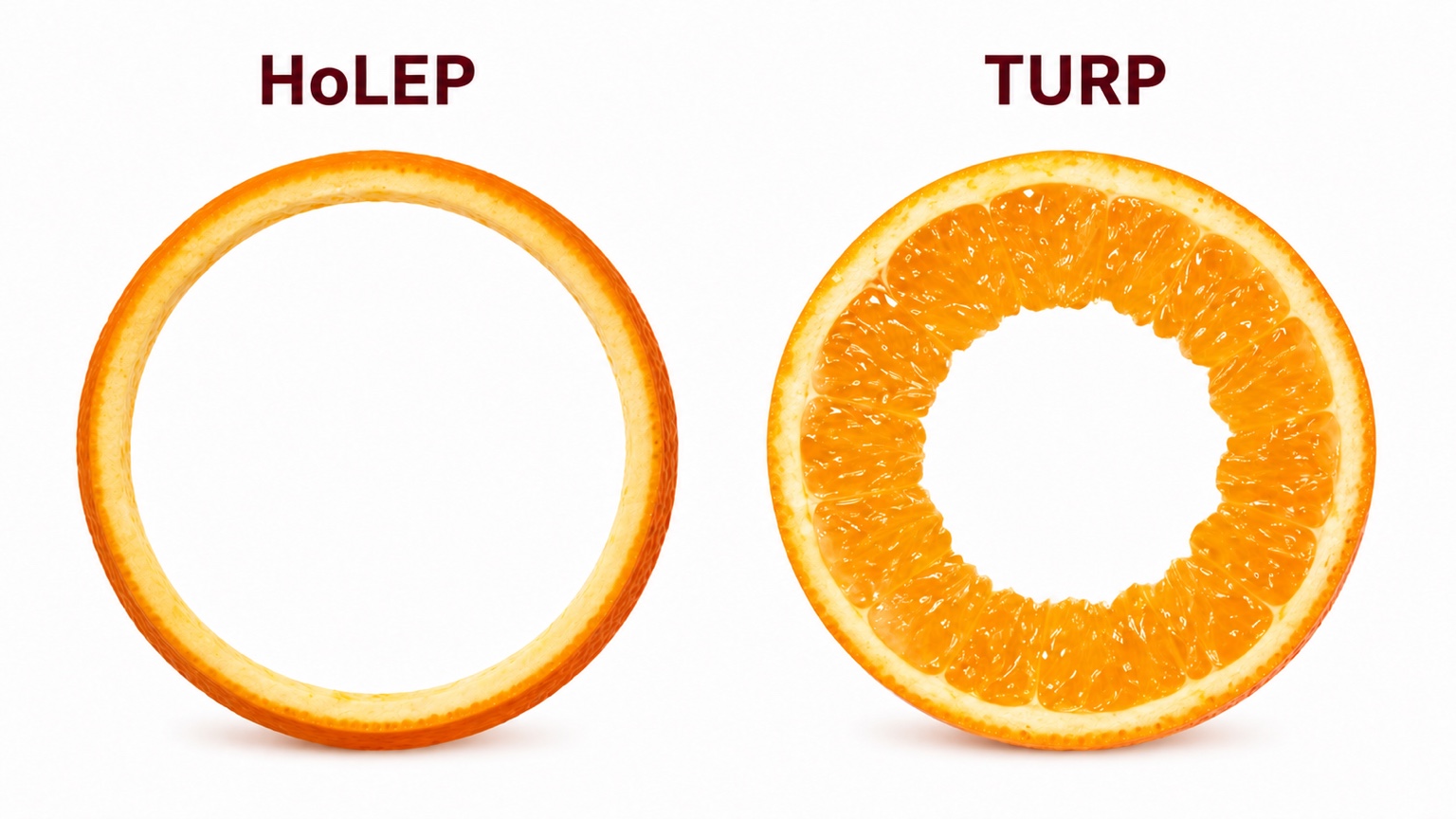
HoLEP and TURP — an illustrated comparison of enucleation and resection.
The illustration simplifies the principle of the operations. The outer part of the prostate is preserved in both procedures.
Prostate size: an important advantage of HoLEP
HoLEP can be used for small, medium and very large prostates. European guidelines most commonly recommend TURP for prostates with a volume of 30 to 80 ml, whereas HoLEP has a wider range of application. [3]
A larger prostate requires more tissue to be removed. Even a very large prostate can be treated with HoLEP through the urethra, in a centre with the appropriate equipment and an experienced surgeon. [1]
Long-term results: how likely is another operation?
Patients need to know how long the improvement in urination will last and how likely they are to need treatment again.
Durability is one of the important advantages of HoLEP. In one randomised study, after approximately seven years, improvement in urination was similar after HoLEP and TURP, but fewer patients needed another operation for prostate enlargement after HoLEP. The number of patients available for this long-term follow-up was small. [4]
For prostates larger than 80 ml, another direct comparison with bipolar TURP found fewer repeat operations and less need to restart medication after HoLEP during three years of follow-up. [3]
Further surgery may also be needed for narrowing of the urethra or bladder neck. These interventions should be distinguished from repeat operations for prostate enlargement. [3]
Less bleeding
HoLEP allows thorough removal of enlarged tissue with good control of bleeding.
Compared with conventional monopolar TURP, many studies show less blood loss and a lower need for transfusion after HoLEP. [5]
Advantages have also been shown in some comparisons with bipolar TURP, including patients with large prostates. The size of the difference depends on the patients studied and the particular outcome measured. [3]
Less time with a catheter and a shorter hospital stay
After both operations, a urinary catheter is temporarily inserted — a thin tube that drains urine from the bladder.
After HoLEP, the catheter is often removed earlier and the hospital stay can be shorter than after TURP. These advantages have been recorded in many comparative studies. [5]
The exact time of catheter removal and discharge depends on bleeding, bladder emptying and the patient’s general condition. HoLEP itself can take longer than TURP, even though catheterisation and the hospital stay may be shorter. [5]
Burning, frequency, sudden urges and occasional blood in the urine may occur during the first weeks. These symptoms usually gradually lessen as healing progresses. The timing of a return to greater physical exertion depends on recovery and the urologist’s advice. [6]
Erections and ejaculation: what changes?
It is important to distinguish an erection, the firming of the penis, from ejaculation, the release of seminal fluid (semen).
Erections are usually preserved
Most men retain the ability to have erections after HoLEP. Studies comparing HoLEP and TURP generally show similar effects on erectile function. [7]
The ability to have an orgasm is usually preserved, although the sensation may be different after a change in ejaculation. [7]
Ejaculation often changes after both operations
After standard HoLEP, orgasm without visible release of seminal fluid is common. This is also called a “dry orgasm”.
A common mechanism is retrograde ejaculation: seminal fluid goes towards the bladder rather than out through the urethra. This change is also common after TURP. HoLEP has no clearly proven advantage over standard TURP in preserving ejaculation. [7]
A change in ejaculation can make natural conception more difficult. Plans to have children and the importance of preserving ejaculation should be discussed before choosing an operation. [2]
Urinary control after surgery
Some patients experience temporary urine leakage after HoLEP — when standing up, coughing or exerting themselves, or with a sudden urge to urinate.
These symptoms usually gradually improve over the following weeks and months. Correctly performed pelvic floor exercises can help urinary control recover. [6]
In pooled results from several studies, rates of stress urinary incontinence were similar after HoLEP and monopolar TURP. [3]
Long-term urine leakage is possible and requires a follow-up assessment and appropriate treatment. [6]
Why does the surgeon’s experience matter?
The surgeon’s experience is a key factor in the safety of HoLEP, as emphasised in European urological guidelines. [3]
Patients should have the procedure in a centre that uses the method regularly, monitors its results and provides follow-up during recovery.
At your appointment, discuss the expected improvement in urination, bleeding, the catheter, urinary control and sexual function. The team’s own results and experience with prostates of a similar size are an important part of that discussion.
HoLEP or TURP — where does HoLEP have an advantage?
HoLEP stands out for anatomical removal of the adenoma and its wider application across prostate sizes. [1]
The choice between HoLEP and TURP is based on assessment findings, health and the patient’s priorities. The aim is thorough relief of the obstruction, a durable result and a clear discussion of recovery and possible changes after surgery.
Medical sources
- BAUS — Prostate Operations
- Fernando Gómez Sancha — a patient guide to HoLEP
- EAU Guidelines — Management of Non-neurogenic Male LUTS, 2026
- Gilling et al. — HoLEP and TURP: results after seven years
- Yin et al. — meta-analysis of randomised comparisons of HoLEP and TURP
- BAUS — HoLEP: information for patients
- Briganti et al. — sexual function after HoLEP and TURP