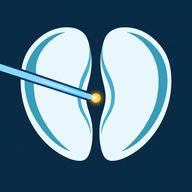
What is a transperineal fusion prostate biopsy?
A prostate biopsy is a diagnostic procedure in which a thin needle takes small tissue samples for examination by a pathologist. The pathologist looks at them under a microscope to establish whether cancer cells are present and, if so, what their characteristics are.
“Fusion” means combining previously acquired MRI images with the ultrasound view of the prostate during the biopsy. This helps the doctor guide the needle towards suspicious areas identified beforehand. [5]
“Transperineal” means the biopsy needle passes through the skin of the perineum, the area between the scrotum and anus. An ultrasound probe is placed in the rectum to show the prostate, while the needle reaches it through skin that has been cleaned with antiseptic. [2]
What are the advantages of the transperineal approach?
Lower risk of infection
The main advantage is that the biopsy needle does not pass through the rectal wall. This reduces the chance of carrying bowel bacteria into the prostate and bloodstream.
Because of the lower risk of infectious complications, European urological guidelines favour the transperineal approach. However, the risk of infection is not completely eliminated.
Good access to different parts of the prostate
The transperineal approach allows sampling of different prostate regions, including the front of the gland, which can sometimes be harder to reach through the rectum.
Can be performed under local anaesthesia
The procedure can be performed with local anaesthetic to numb the skin and deeper tissues. The type of anaesthesia is tailored to the planned procedure and the patient’s needs. [1]
When is a fusion prostate biopsy recommended?
A fusion biopsy is considered when MRI shows a suspicious area and the overall assessment indicates that tissue samples are needed.
The urologist takes the following into account:
- the PSA level and how it has changed;
- prostate size and PSA density, the ratio of PSA to prostate volume;
- examination findings;
- the appearance of changes on MRI;
- a family history of prostate cancer;
- the results of previous biopsies.
A raised PSA or suspicious MRI finding does not automatically mean that cancer is present. The decision to perform a biopsy combines the findings with the individual risk. [1]
Why are MRI and targeted sampling important?
MRI helps identify areas needing particular attention before the biopsy. Fusion guidance then allows samples to be taken specifically from these areas.
The aim is to detect clinically significant cancer, a tumour whose characteristics may influence treatment decisions.
Alongside targeted samples, additional samples may be taken from surrounding tissue or other parts of the prostate, depending on the findings and previous investigations. The number and distribution of samples are planned for each patient. [6] [5]
How should you prepare for a biopsy?
Before the procedure, patients receive individual instructions. Bring the MRI report and images, PSA results, previous biopsy results and a list of medicines.
Medicines affecting blood clotting
Tell your team about any anticoagulant or antiplatelet treatment and why you take it.
Do not stop or change treatment on your own. The doctor decides whether a pause is needed and when treatment should restart, taking into account the risks of bleeding and blood clots. [3]
Infections, allergies and antibiotics
Report allergies, previous problems with antibiotics, fever, burning or other symptoms of a urinary infection. Necessary tests, including checking urine, are arranged according to the assessment.
The need for an antibiotic depends on the centre’s protocol and individual risk. Take antibiotics only as instructed.
Food, drink and someone to accompany you
Instructions depend on the type of anaesthesia. Fasting is often unnecessary for local anaesthesia, while sedation or general anaesthesia requires specific instructions.
Arrange transport and someone to accompany you in advance if sedation or general anaesthesia is planned. [4]
How is a transperineal fusion biopsy performed?
The patient lies on their back with their legs supported. The perineal skin is cleaned with antiseptic, and appropriate anaesthesia is then given.
An ultrasound probe shows the prostate during the procedure. The fusion system combines the ultrasound view with suspicious areas previously marked on MRI. The doctor then passes the biopsy needle through the perineal skin and takes the planned samples.
The samples are labelled according to where they were taken and sent for examination by a pathologist.
The procedure usually takes around 30–45 minutes, varying with the number of suspicious areas, the extent of sampling and the type of anaesthesia. Most patients go home the same day after appropriate observation.
Does the biopsy hurt?
The local anaesthetic injection may sting briefly. Pressure and short-lived discomfort are possible during sampling. Tell the doctor immediately if you feel pain so that pain relief can be adjusted. [2]
What side effects and complications are possible?
After a biopsy, you may experience:
- a small amount of blood in the urine;
- blood or discolouration of seminal fluid;
- mild pain, tenderness or bruising of the perineum;
- temporary burning or difficulty urinating.
Blood in seminal fluid can persist for several weeks, sometimes longer. This alone does not mean there is a serious complication.
Some patients may also notice temporary changes in erections.
More significant bleeding, infection or an inability to urinate occur less often. Urinary retention may require a temporary catheter. Although infection is less common after a transperineal biopsy, its symptoms need to be recognised promptly. [3] [4]
What does recovery involve?
Rest and light activities are recommended on the first day. Greater physical exertion, heavy lifting, cycling and resuming sexual activity should be guided by recovery and the instructions you receive.
Drink according to your doctor’s advice. If you have a fluid restriction because of heart or kidney disease, follow your individual plan.
Use pain relief and antibiotics, and restart medicines affecting blood clotting, according to your instructions.
Before going home, make sure you know whom to contact if symptoms develop and when a follow-up appointment to discuss the biopsy results is expected. [3]
When should you seek medical help immediately?
Seek medical attention without delay if you develop:
- fever, particularly with chills or marked weakness;
- an inability to urinate;
- heavy or persistent bleeding, especially with clots;
- severe or increasing pain;
- a sudden deterioration in your general condition.
Do not wait for a scheduled follow-up in these situations. [4]
What does the pathology report tell us?
The report shows whether cancer cells are present in the samples. If cancer is confirmed, its characteristics are assessed, including the Gleason score and ISUP grade group, which help estimate its aggressiveness.
A cancer diagnosis does not mean that every patient needs immediate surgery. The decision depends on the biopsy findings, PSA, imaging, health and estimated risk. Active surveillance is possible for selected tumours. [5]
A negative biopsy does not always end follow-up. If suspicion remains, the urologist plans further monitoring and any additional investigations. [1]
My message to patients
When prostate cancer is suspected, it is important to assess carefully who needs a biopsy and how best to perform it.
Transperineal fusion biopsy combines targeted sampling of suspicious areas with the advantages of an approach through the perineum. However, a good diagnostic process begins before the samples are taken, with careful assessment of PSA, MRI, previous findings and individual risk.
My aim is for patients to understand why a biopsy is proposed, what it involves and how its result may influence subsequent decisions.
Medical sources
- EAU — prostate cancer diagnostic evaluation guideline
- BAUS — transperineal prostate biopsies
- Leeds Teaching Hospitals — transperineal prostate biopsy
- University Hospitals Sussex — transperineal biopsy under local anaesthetic
- Cambridge University Hospitals — prostate cancer assessments and treatments
- UCLH — diagnosing prostate cancer