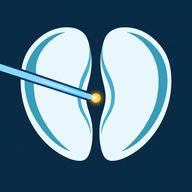
The key difference is not just the type of laser, but what happens to the tissue obstructing urination. It can be separated along its anatomical boundary and removed, gradually removed with vaporisation, or treated with heat so that it shrinks over time.
HoLEP stands out for thorough removal of the adenoma, its use even in very large prostates, well-documented long-term results and the availability of removed tissue for examination by a pathologist. [2] [4]
How do laser procedures differ?
The differences depend on how the enlarged tissue obstructing urination is treated.
In HoLEP, the tissue is separated along its anatomical boundary and removed. The surgeon follows the natural plane between the adenoma, the enlarged inner part of the prostate, and the surrounding tissue. The separated adenoma is then broken up in the bladder and removed. This process is called enucleation. Unlike radical surgery for cancer, the whole prostate is not removed, only the part obstructing urine flow. [2]
In thulium vaporesection, the tissue is gradually cut into smaller pieces and partly vaporised. The removed pieces can be sent for examination by a pathologist. [10]
In GreenLight vaporisation, the tissue is vaporised with laser energy. Gradual vaporisation widens the channel through the prostate. Pure vaporisation does not provide a tissue sample for examination by a pathologist. [3]
In TPLA, the tissue is treated with heat through thin laser fibres inserted through the perineal skin. It remains in the prostate, and gradual shrinkage can reduce pressure on the urethra. [1]
Advantages of HoLEP
The advantages of HoLEP concern improvement in urination, durability of results and use across different prostate sizes.
Thorough removal of the obstruction to urination
HoLEP allows anatomical removal of the enlarged inner part of the prostate pressing on the urethra. This creates a wide channel for urine, usually leading to a stronger stream, easier urination and better bladder emptying.
It is also particularly useful for patients who have a catheter because they cannot pass urine. Success in these patients also depends on how well the bladder still functions. [2]
Long-lasting results and a low need for repeat adenoma removal
HoLEP has well-documented long-term results, including studies with ten years of follow-up. Improvements in urination can be maintained for a long time, and the need for another operation because of remaining or regrown adenoma is low.
However, further treatment may sometimes be needed for other reasons, such as scar-related narrowing of the urethra or bladder neck. [4] [5]
Treatment even for very large prostates
HoLEP is used across a wide range of prostate sizes, including very large glands. In these patients, it allows a large amount of adenoma to be removed endoscopically through the urethra, without a skin incision. [2]
Tissue available for examination by a pathologist
The removed tissue is examined under a microscope to establish its nature and identify any unexpected changes.
This is an additional advantage over pure GreenLight vaporisation and TPLA, which do not remove tissue for analysis during the treatment itself. Unlike pure vaporisation, thulium vaporesection can also provide tissue for examination. [2] [3] [10] [1]
HoLEP or thulium vaporesection?
Thulium vaporesection, or ThuVARP, can relieve symptoms and improve urination. The main difference from HoLEP is how tissue is removed: vaporesection gradually removes smaller pieces while also vaporising some tissue.
An advantage of HoLEP is separation of the adenoma along its natural anatomical plane and its thorough removal, including in very large prostates. [2]
For HoLEP, we have more information about long-term results. European urological guidelines give HoLEP a strong recommendation, while the recommendation for thulium vaporesection is weak, with fewer high-quality comparative studies with longer follow-up. This reflects the strength of evidence for choosing a procedure, rather than proving that every patient will have a better outcome after HoLEP. [1]
Both procedures can provide tissue for examination by a pathologist. [10]
It is important to check exactly what is meant by “thulium surgery”. Thulium enucleation, or ThuLEP, is a different procedure from vaporesection: it follows the same anatomical principle as HoLEP and has comparable results. [6]
HoLEP or GreenLight vaporisation?
GreenLight vaporisation, also known as PVP, is an established procedure that can significantly improve urination, with good bleeding control and often a short hospital stay. [3]
HoLEP particularly stands out when a large adenoma needs to be removed. European guidelines primarily recommend GreenLight vaporisation for prostate volumes of 30–80 ml, while HoLEP has a wider range of applications in terms of prostate size. GreenLight can also be used for larger glands, but evidence for this use is more limited. [1]
In some direct comparisons, HoLEP produced greater improvements in urinary flow. Outcomes also depend on bladder function and other individual circumstances. [7]
Another clear advantage of HoLEP is that tissue is available for examination by a pathologist. In pure GreenLight vaporisation, the tissue is vaporised and no sample remains. After HoLEP, the removed adenoma is sent to a pathologist for examination under a microscope. [2] [3]
When comparing durability, older and newer GreenLight systems should be distinguished. Newer systems also have favourable results over several years. [8]
HoLEP or TPLA?
TPLA can usually be performed under local anaesthesia. Urination improves gradually as the heat-treated tissue shrinks over the following weeks and months. [1]
The main advantage of HoLEP is immediate removal of the obstructing tissue. The adenoma is separated and removed during the operation, so opening the channel for urine does not depend on subsequent shrinkage of treated tissue.
However, this does not mean that all symptoms disappear immediately. The bladder and operated area need time to recover, and frequency and sudden urges to urinate may settle gradually. [2]
HoLEP has a much more mature evidence base for long-term effectiveness. TPLA has encouraging results, but larger comparative studies with longer follow-up are needed. The procedures therefore cannot be presented as equally well established in terms of durability. [1] [4]
Another advantage of HoLEP is examination of the removed tissue. With TPLA, the tissue remains in the prostate, and the treatment does not provide a sample for examination by a pathologist. [1] [2]
TPLA has a place in carefully selected patients, particularly when local anaesthesia and preservation of ejaculation are important. Standard HoLEP often results in the absence of visible emission of seminal fluid, which is not the same as losing erections. [9] [2]
A message for patients
HoLEP stands out for thorough removal of the adenoma, use even in very large prostates, well-documented long-term results and the opportunity to examine removed tissue.
The procedure should be tailored to prostate size and shape, symptom severity, bladder function, general health and the patient’s expectations. The surgeon’s experience with the particular procedure also matters. [1]
Before making a decision, expected improvement, recovery and possible adverse effects are discussed. Like other operations, HoLEP has risks, including bleeding, infection, temporary or less commonly persistent urine leakage, scar-related narrowing and changes in ejaculation. [2]
My message to patients is simple: ask how the proposed procedure removes the obstruction, how durable its results are and why it suits your particular findings. This will help you understand what to expect from treatment.
Clinical sources
- EAU — guidelines on non-neurogenic male lower urinary tract symptoms, 2026
- BAUS — patient information on HoLEP
- BAUS — patient information on GreenLight vaporisation
- Elmansy et al. — long-term outcomes after HoLEP, 2011
- Fallara et al. — ten-year follow-up after HoLEP, 2021
- Pirola et al. — comparison of HoLEP and ThuLEP, 2018
- García Rico et al. — comparison of GreenLight vaporisation and HoLEP, 2026
- Ajib et al. — five-year outcomes of GreenLight XPS-180 W, 2018
- Bertolo et al. — TPLA and preservation of ejaculation, randomised trial, 2023
- UNBLOCS — randomised trial of thulium vaporesection and TURP, 2020